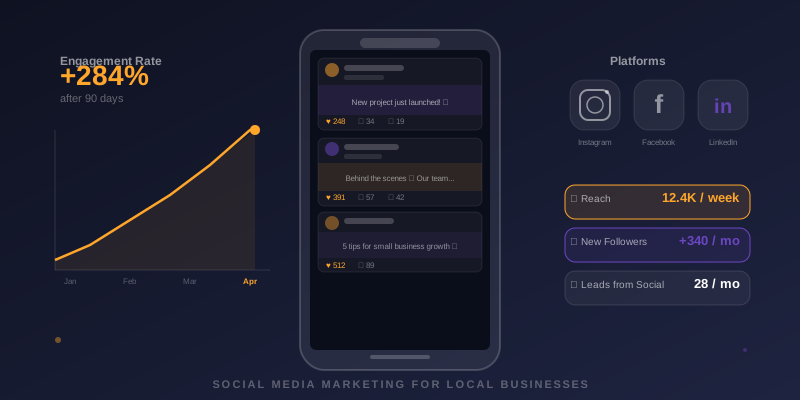
There is a trap that swallows hundreds of hours of small business owner time every year: optimizing for social media metrics that do not correspond to revenue. Follower count, likes, reach, impressions — these numbers feel like progress because they go up. But a local business with 12,000 Instagram followers and 8 paying customers per month from social is doing something fundamentally wrong. A business with 900 followers and a clear conversion strategy can drive 40+ customers per month from the same platforms.
This playbook is about the second approach. Here is what actually works for US local businesses trying to turn social media into a real customer acquisition channel.
Step 1: Choose One Platform and Do It Well
The biggest time-waster in small business social media is trying to maintain a presence on Facebook, Instagram, TikTok, LinkedIn, and X simultaneously. The result is mediocre content across all platforms and no traction on any of them. The algorithm on every platform rewards consistent, high-engagement content — and you cannot produce that at scale without a dedicated team.
Choose your primary platform based on where your customers actually spend time. For most consumer-facing local businesses (restaurants, salons, retail, contractors, healthcare, fitness), Facebook and Instagram offer the best combination of audience size and local targeting. Facebook's local business ads are the most powerful local advertising tool available at a small budget. Instagram works especially well for visually rich businesses — food, interior design, before/after service work.
For B2B service businesses (accounting, legal, marketing, software), LinkedIn is where the decision-makers are. Post on your secondary platforms just enough to maintain a presence, but invest your real effort in one.
Step 2: Content That Converts — The 3 Types That Work
Not all content drives customers. Inspirational quotes, generic stock photos, and promotional posts asking people to "call now" are the three content categories that consistently underperform. The content that builds trust and drives action falls into three categories:
Social proof content. Real customer results, before/after photos, testimonials in video or text form, and reviews. This is the most powerful conversion content a local business can post. A 30-second video of a satisfied customer explaining why they chose you and what changed is worth more than 20 promotional posts. Get permission, film it on your phone, post it raw — the authenticity is the point.
Process and behind-the-scenes content. Show people how you work. A plumber narrating a pipe repair as they do it. A web designer walking through a redesign before/after. A chef prepping the day's ingredients. This content builds expertise positioning while revealing the human side of the business. It answers the question customers are silently asking: "Do these people actually know what they're doing?" in the most credible possible way.
Local relevance content. References to your neighborhood, local events, community involvement, and nearby landmarks signal to your audience that you are genuinely local — not a franchise or remote provider pretending to be. Tag local landmarks. Mention the neighborhood by name. Share local events you are part of. This is what differentiates a local business from a national competitor on social media, and it is something they cannot replicate.
Step 3: The Local Ad Strategy That Gets Customers Without a Big Budget
Organic social reach for business pages has declined significantly over the past several years. For most local businesses, organic posts reach only 2–5% of their followers. This means if you want social media to be a reliable customer acquisition channel, a modest paid ad budget is non-negotiable.
The good news is that local ad targeting is extraordinarily efficient when done correctly. A $300/month Facebook ad budget targeted to a 5-mile radius around your business, promoting a specific offer to your ideal customer demographic, can produce results that a $3,000 radio ad cannot match — because every dollar goes to exactly the people most likely to walk through your door.
The most effective ad formats for local businesses in 2026 are: Lead generation ads (customer fills out a form directly in the app — no website visit required), Local awareness ads with a map and "Get Directions" button, and short video testimonial ads (15–30 seconds). Start with a $10/day budget, run for 14 days, review results, and optimize. Do not boost random posts — build campaigns with a specific objective and a clear offer.
Step 4: The Conversion Bridge — From Social to Sale
Most local businesses treat social media as a broadcasting channel with no clear next step for interested followers. Every piece of content should have a path — even if it is subtle — that moves an interested viewer toward becoming a customer. This is the conversion bridge.
Your bio link should go to a dedicated landing page, not your homepage. That page should have one offer, one call to action, and zero distractions. For a service business, this might be "Book a Free Consultation" with a scheduling link. For a restaurant, it might be an OpenTable reservation link. For a retail business, it might be a coupon code redeemable in-store.
In your post captions, include a clear and specific call to action on every post that has conversion intent — not on every post, but on the ones designed to drive action. "DM us 'QUOTE' for a free estimate" is more actionable than "learn more in bio." The easier you make it to take the next step, the more people will take it.
If you want a social media strategy built around your specific business and customer base, BizmaTech can help you build a system that drives real leads — not just vanity metrics.
Frequently Asked Questions
Which social media platform is best for local businesses?
Facebook and Instagram offer the best return for most consumer-facing US local businesses. Facebook has the most powerful local ad targeting. Instagram works especially well for visual businesses. For B2B services, LinkedIn is more effective. Start with one platform and do it well.
How often should a small business post on social media?
Consistency matters more than frequency. 3–4 posts per week on your primary platform is far more effective than daily posting that burns out quickly. Plan content in weekly batches and use a scheduling tool to maintain consistency without daily effort.
How do I get more engagement on social media as a local business?
Show the people behind the business. Customers engage with humans far more than with products or promotional posts. Post process videos, team moments, behind-the-scenes content, and real customer results. Respond to every comment within the first hour to signal engagement to the algorithm.
Should local businesses run paid social media ads?
Yes. Even $10/day in Facebook or Instagram ads with geo-targeting to a 5-mile radius can generate significant local awareness and leads. The key is targeting precision and a clear offer — not boosting random posts. Start with a lead generation or local awareness campaign.
How do I measure if social media is actually bringing in customers?
Ask every new customer how they found you and track the answers. Set up UTM link tracking for any links you post. If you run local ads, use Meta's conversion tracking. The simplest metric: of every 10 new customers this month, how many mention social media?