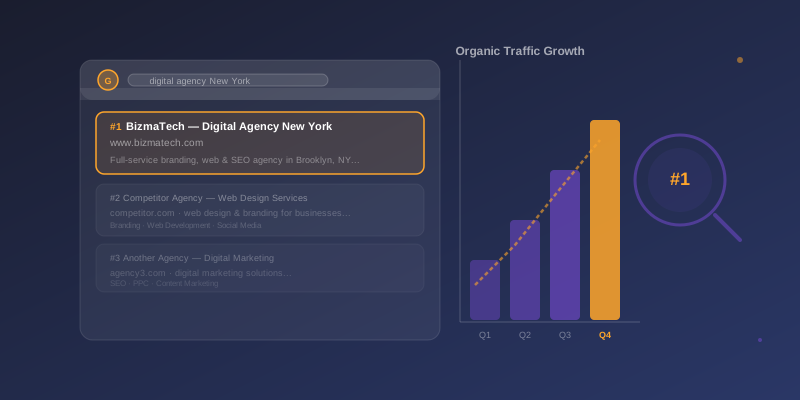
Every month, millions of Americans search Google for a plumber, a dentist, a web designer, or a restaurant — and they click one of the first three results. If your business is not in that top-three pack, you are invisible to most of those potential customers. The good news is that local SEO is still one of the most level playing fields in digital marketing — and you do not need a $5,000/month agency to compete.
This playbook covers the specific actions that move the needle for US small businesses in 2026. No fluff. No generic advice. Just what actually works.
Step 1: Own Your Google Business Profile (This Is Non-Negotiable)
Your Google Business Profile (formerly Google My Business) is the single most important asset in local SEO. It controls what appears in the Map Pack — the three highlighted results that appear above organic listings when people search for local businesses. If you have not claimed, verified, and fully completed your profile, stop reading and do that first.
Completion matters more than most people realize. Businesses with complete profiles get 7× more clicks than incomplete ones. That means: every category filled in, correct hours including holiday hours, a detailed business description with your key service keywords, 20+ photos updated regularly, and your full address with service area defined. A profile that looks like an afterthought performs like one.
Post to your GBP weekly. Google treats regular activity as a signal that a business is open and engaged. Posts can be offers, events, new services, or answers to common questions. It takes 10 minutes a week and most of your competitors are not doing it.
Step 2: Reviews Are Currency — Start Earning Them Systematically
Review volume and recency are among the strongest local ranking factors Google uses. A business with 200 reviews at 4.6 stars will outrank a competitor with 18 reviews at 4.9 stars in most markets. Volume signals that real people trust you enough to leave feedback. Recency signals that you are still actively serving customers.
The easiest way to get reviews is to simply ask — at the right moment. After a successful job, transaction, or appointment, send a follow-up text or email with a direct link to your Google review page. Make it one tap. Do not overthink the message: "Hi [Name], thanks for choosing [Business]. If you have 60 seconds, a Google review would mean a lot to us: [link]." That alone, done consistently, will build your review count faster than any software platform.
Never buy reviews or incentivize them. Google's detection systems are sophisticated, and a penalty will undo months of work.
Step 3: Build Local Citations — Consistently
A citation is any mention of your business name, address, and phone number (NAP) on another website. The major directories — Yelp, Bing Places, Apple Maps, Yellow Pages, the Better Business Bureau, your local Chamber of Commerce — each act as a vote of legitimacy for your business in Google's eyes.
Consistency is more important than volume. If your address appears as "123 Main St" on Google and "123 Main Street Suite 4" on Yelp and "123 Main St." on Bing, the inconsistency sends a confusing signal and reduces ranking power. Audit your existing listings, clean up mismatches, and then systematically add your business to the top 20 directories. Tools like BrightLocal or Whitespark can help automate this if you have multiple locations.
Step 4: Create Local Content That Answers Real Questions
Content is how you compete for organic search rankings beyond the Map Pack. The businesses that dominate local organic results are usually the ones with service pages and blog content that directly answers the questions people in their area are actually searching for.
For a web design company in Brooklyn, that means content like "how much does a website cost for a small business in New York" or "best web design company for restaurants in Brooklyn." These are long-tail searches with lower competition and high purchase intent. One well-written, 1,000-word page targeting a specific local question can drive consistent leads for years at zero ongoing cost.
The key is specificity. Generic content about "web design services" gets buried. Content that answers a real question a real local customer is typing into Google gets found.
Step 5: Get Your Website's Technical Foundation Right
All the GBP optimization and content in the world will underperform if your website is slow, not mobile-friendly, or missing basic on-page SEO signals. Google's Core Web Vitals — page load speed, interactivity, and visual stability — are ranking factors, and many small business websites fail them badly.
Run your site through Google's PageSpeed Insights (free). If your mobile score is below 70, that is costing you rankings. Common fixes include: compress images before uploading, enable browser caching, use a CDN, and defer non-critical JavaScript. On the content side, make sure every page has a unique title tag and meta description that includes your primary keyword and city.
If your site needs a complete technical overhaul, that investment pays for itself many times over in organic traffic. BizmaTech builds SEO-ready websites for US small businesses — schedule a free consultation to see what's holding your site back.
Frequently Asked Questions
What is local SEO and why does it matter for small businesses?
Local SEO is the process of optimizing your online presence so your business appears when people nearby search for your services. It matters because 46% of all Google searches have local intent — people looking for businesses near them and ready to buy.
How long does SEO take to show results?
Google Business Profile optimizations and citation building typically show results in 4–8 weeks. Organic content-based SEO takes 3–6 months. Consistent effort over time is far more effective than one-time bursts of activity.
What is the most important ranking factor for local SEO?
Google uses proximity, relevance, and prominence as the three core local ranking factors. For most small businesses, GBP completeness and review volume are the fastest levers to pull immediately.
How much should a small business spend on SEO?
Strong local SEO results are achievable with $500–$2,000/month or 5–10 hours of consistent in-house work per week. The fundamentals — GBP optimization, local content, and review generation — are accessible to any business with or without a large budget.
What is the difference between local SEO and organic SEO?
Local SEO targets geographic searches (near me, in [city]) and focuses on the Map Pack. Organic SEO targets broader rankings across all locations. For a local business, local SEO delivers faster and more relevant traffic.